Foreword
Sooner or later, human-AI collaboration ends up inside professional workflows, and in creative fields it seems to have made a soft landing, without much of a stir: in December 2022, artists began dropping “No AI Art” images into their ArtStation portfolios, and a protest took off from there1. Licensing deals and copyright suits followed; in time, collaboration settled into professional workflows2. The people who protested back then rarely speak up now. The ecosystem is no healthier for it: the settlements were bought with money, and the litigation continues3. Take the music industry: UMG settled with Udio and signed a licensing deal, Warner settled with Suno, and Sony’s suit is still going in Massachusetts, with a new lawsuit filed in March 20263.
This time AI is entering research, and at first glance the story looks much the same: research is creative work too. What is different is that it runs on an older set of rules. Its problems are thornier as well: the process is invisible, and there is no single party to negotiate with. Our question is what kinds of collection and publication are acceptable once AI becomes a collaborator in research. I cannot predict when AI will independently produce a major result, nor can I judge the model capabilities of any specific company, and I have no intention of wading into the argument over which technical path is worth taking.
My position: collecting research traces is not itself the problem; how results are obtained, and how they are announced, is what decides the consequences. What follows asks three questions, across three layers — facts, mechanisms, institutions:
- Who is collecting the data, at what price, and what it actually gets;
- Why attribution and credit, the machinery for tracing things back, is fragile and why it can still be repaired;
- What we have left once checking paper by paper can no longer keep up with the pace of generation.
Now You See Its Head, Never Its Tail: A Process Never Recorded in Full
Put simply, research is a line of work whose results are written into papers, while the forks in the road and the dead ends along the way are not — you see the dragon’s head, never its tail (see the figure below).
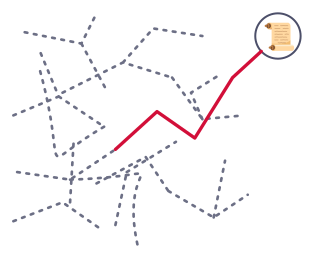
One path, and the forks around it
The red line is the path written into the paper; the gray dashed lines are the other options that failed or were passed over, and only what lies inside the white circle is the result that was finally published.
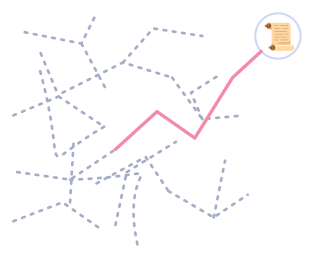
One path, and the forks around it
The red line is the path written into the paper; the gray dashed lines are the other options that failed or were passed over, and only what lies inside the white circle is the result that was finally published.
In a traditional creative workflow, the work itself is everything. Brushstrokes, editing, and camera movement exist only inside the finished piece; an outsider cannot tell the order in which they were set down. The process behind research is just as hard to reconstruct in full: you cannot look at a published paper and see the shape of its first draft, or which directions its authors abandoned, or where they ran into walls. The process does leave traces, but they are scattered across conference hallways, mailing lists, and lab whiteboards, and across the spoken exchanges between advisors and students; over time, most of them survive only in the memory of someone involved and a single line in an acknowledgments section.
At the same time, research prizes accumulation and dissemination: every valuable step forward is recorded — papers, preprints, conference talks, textbooks — and words and images preserve its conclusions in full detail. This looks like a good thing, and it also means that only the results are visible, never the road that led to them.
More troublesome still: even where records exist, what we can get is mostly incomplete. A lab notebook records what was done but rarely why another path was abandoned; a code repository keeps the final version, while the failed branches in between have usually been deleted long ago. Most of these omissions happen simply because there was nowhere to write them down; not all of them are deliberate.
Research is, at bottom, creative work, though its rigorous exterior often hides the fact: its output rests on combinations that have never existed before, and whether a combination holds up can only be learned by trying it. That invisible process is exactly the scarce resource. Terence Tao wrote on September 8, 2026: “it is now the identification of a promising problem which is the scarce and precious resource.”4 If what used to be scarce was compute, what is scarce now is the ability to recognize a good problem. That ability grows out of trial and error, and trial and error is precisely the part that is hardest to record and hardest to price; all we ever see afterward is the one question that held up. What research traces capture is exactly the attempts that were given up.
Industry has already given a price signal. Mercor, a data company that pairs AI labs with domain experts, passed $2 billion in gross annualized revenue in June 2026: total revenue before payouts to experts, not net income5. Loose as that accounting is, it shows demand is real: once a person’s judgment in some field is recorded, it becomes an asset that can be sold. Research traces of this kind are worth collecting, and should be collected. The research traces that arise from human-AI interaction are data that did not exist before the AI era, that has not been completely recorded even as the era gets underway, and that cannot be reverse-engineered from any finished product. If we are to reach the AGI described in my previous article, progress toward it depends on data like this; and to exclude such data from the material that intelligence develops on strikes me as untenable. Would no one come to collect it?
The Next Gold Rush: Seats, Prices, and Auditable Artifacts
Anthropic has already begun collecting research-trace data. On August 27, 2026, it announced a support program for scientists: Principal Investigators (PIs) at academic or nonprofit research institutions can apply once verified. The program offers 10,000 Claude seats (that is, subscription slots), with standard seats free and premium seats carrying 5x usage limits at $15 per month for a term of one year. The announcement adds that the number of seats will grow from there6. The program also includes AI for Science projects, with a cap of $50,000 per project. Ten thousand seats does not sound like much, but they go to verified researchers — the people most likely to leave behind high-quality research traces. The one-year term also marks this as an experiment: first see whether these traces are worth anything, then decide whether to make the program routine.
Taken together, these moves do not look much like charity: free and low-priced seats buy two kinds of assets, one being the distribution of real problems, the other samples of research traces. The first decides where the next model gets trained; the second decides whether it can learn to think like a researcher. A researcher’s judgment cannot be sampled at scale, in real settings; it can only be recorded, one real problem at a time.
For researchers, the terms are tempting: an assistant that has read the whole literature and will answer questions on demand, offered to you at a rock-bottom price or for free, with compute credits thrown in. Those who accept it will not feel they are giving anything away, and it is hard to blame them.
By the official account of the Claude Science workbench, the point is to preserve the research process as auditable artifacts7. “Auditable” refers to the process leaving a trail; it says nothing about where the corpus came from. Trace data does not need to be taken secretly — it is part of the product itself. Every question you ask in the workbench, every line of thinking you abandon, stay behind, and the deeper you go, the more complete the record. These records are what the vendors are after: the subscription fee is a rounding error; the records are what is truly valuable, and contracts rarely spell out that exchange of interests so plainly.
In August 2025, xAI made Grok Code Fast 1 free for a limited time to users of several coding tools, pushing API pricing down to $0.20 per million input tokens and $1.50 per million output tokens8; Google’s Gemini CLI was more direct still: sign in with a personal account and you get 60 requests per minute and 1,000 per day, free9. Free is a price too, and what it collects is exactly traces. Trade a low price for usage, then take the traces that usage leaves behind and train the next generation of models on them — a route the coding tools already rehearsed. For vendors, expert judgment can be bought with money; research traces are not on the open market, and the only way to get them is to trade product experience for them.
At this pace, within a year or so, vendors in China and abroad will push collection forward in earnest. A price war comes first, then a jump in the number of seats, and after that traces enter the training data manifest. Only when people feel that traces drawn from expert experience have begun to saturate will the freebies be clawed back. Collection itself I have no objection to; what needs watching is how the data is obtained and how results are announced: get those two steps wrong and the more traces you collect, the bigger the problem grows.
So where do AI results currently stand in the academy? When AI takes part in research, some results do get the academy’s blessing. Half of the 2024 Nobel Prize in Chemistry went to Demis Hassabis and John Jumper for AlphaFold2’s prediction of protein structures10; in a related vein, DeepMind’s GNoME put out 2.2 million new crystal structures in one go in 202311. The Nobel Committee wrote a tool into its citation, while attribution and responsibility stayed with people. Google’s AI co-scientist generated and validated candidate hypotheses on antimicrobial resistance mechanisms12. And in August 2026, Anthropic reported that an unreleased research version of Claude raised a lower bound related to the Riemann function from 41.6% to 67.2%, while noting that the Riemann hypothesis itself remains unsolved13.
Together, these examples form a ready-made pattern of acceptance: peers can read them, conclusions can be independently verified, and the names on the work are still human. Of course, some cases have not reached that point: the Riemann result is so far just a company research note. Whether AI can do research may be only a technical question; whether its results get recognized depends on whether our institutions are built to catch them.
Two Controversies: Ten Thousand Agents and One “Autonomous Discovery”
In both episodes, the step that went wrong was the announcement. The first came on September 8, 2026. OpenAI announced that a coordinated group of agents driven by its internal models had proved that the three-dimensional incompressible Navier–Stokes equations develop a finite-time singularity, with the result formally verified in Lean14. The stated scale was around ten thousand concurrent agents. The announcement also said they did not intend to claim the Millennium Prize for the result. Under the Clay Institute’s official statement of the problem, this result corresponds to versions C and D — the singularity-exists (disproof) route — rather than a proof that solutions stay smooth.
Buckmaster, a mathematician working in a closely related area, said in a statement that day that he had asked OpenAI whether the model had read their sessions in Codex, where the drafts for an entire project of theirs were stored, and was told the model did not look up user data; when he pressed them about training, he got no answer15. OpenAI’s response was that neither the researchers nor the agents saw their work before Buckmaster’s side released it publicly, and that no specific user data was accessed to solve the problem; but the first version of the announcement acknowledged that it could not rule out that de-identified data left behind by users had helped improve the model16. This is the classic he-said-they-said: one side recounting what it heard, the other presenting what its own investigation concluded.
There is an earlier layer of dispute in all this, too: how priority and contribution should be divided. The announcement acknowledged the other side’s priority on the forced Euler equations and congratulated them14; Buckmaster’s statement, in turn, records that the original idea for this route belonged to two people who had started earlier still: Diego Córdoba and Luis Martínez-Zoroa15.
Over the following two weeks, the argument shifted to the problem itself: was this even the problem anyone actually cared about? On September 17, a preprint by Constantin, Ignatova, and Vicol showed that the forced construction does not extend to the original problem with the forcing removed17. Luis Silvestre put it bluntly: “The most important problem is unsolved.” As outsiders, we can judge one thing: they did not solve the same problem — the “forced” qualifier is not a detail to be waved away, which means OpenAI’s claimed result is not a simple extrapolation of human methods. But we cannot judge how much the work was inspired by, or more directly helped by, what came before.
The second episode came on September 23. Anthropic announced that Claude had discovered a new enzyme system with properties similar to CRISPR; the official line is that scientists provided only a single high-level hint at a direction, and that the search and screening of candidates were carried out autonomously by agents. The announcement also states that all the wet-lab work was done by human scientists18. The scale: about 950 agents, 21 hours, 210 million tokens, screening roughly 3,500 candidate systems out of more than 200,000 reverse transcriptases. “Autonomous” here refers to the search and the hypothesis generation, not to the absence of human involvement; what the system is good for, no one can say yet, and the preprint has not been peer-reviewed.
The pushback came quickly, and it came with names attached. On September 27, Mario Rodríguez Mestre, a computational biologist at the University of Copenhagen, told The New York Times that his team had been studying this class of enzymes for four years. Over the past three years they had been using Anthropic’s models to write code and draft manuscripts while sharing key findings about the system with Anthropic, and he worries that this information was used to train later models19.
Philip Kranzusch of Harvard Medical School said: “It’s not yet a breakthrough. It’s a wrinkle on what we know in the field.”20 Kevin Blake at the University of Washington was more direct: nothing indicates that this system rivals CRISPR’s gene editing, much less that it could become a drug21. Announce a flashy finding first and release the evidence afterward; by the time anyone really checks, the public impression has already taken hold. In both episodes the skeptics were named, all of them from universities, and their questions fell into two kinds: one asked about provenance — where did the data come from, who got there first; the other weighed the value — does this count as a breakthrough. The two kinds of doubt look different, but follow them far enough and both get stuck at the same point: if the provenance cannot be checked, the credit cannot be figured out.
| OpenAI - Navier–Stokes | Anthropic - ART enzyme system | |
|---|---|---|
| Official line | Roughly 10,000 concurrent agents; finite-time singularity proved; Lean-verified; will not claim the Millennium Prize14 | A single high-level hint; wet-lab work done by human scientists; 950 agents, 21 hours18 |
| Core doubt | Whether their drafts and training data were accessed15 | The enzyme had been studied for four years; were the key findings used to train later models?19 |
| Skeptic and role | Tristan Buckmaster, professor of mathematics, NYU | Mario Rodríguez Mestre, University of Copenhagen |
| Key time gap | Announced roughly 12 hours after the other side’s statement22 | Announced September 23; doubts in print September 27 |
| What followed | Mathematicians question whether the wrong problem was solved; preprint shows the construction does not extend17 | Function unknown, preprint not peer-reviewed; rated “not yet a breakthrough”20 |
| Priority granted? | Yes (related problem only); the announcement credits and congratulates them14 | Not addressed |
Back on September 8, Tao had already written about the long-term cost of this kind of announcement: even a rumor that someone is working on a problem can now trigger a large-scale, AI-driven effort that flattens the problem before the original project has time to grow; the incentives may be shifting toward no longer sharing research directions at all, which would reverse centuries of open-science tradition4. He is not the only one worried about this style of announcement. Twenty-five Fields Medalists wrote in a joint statement: “As in all creative professions, this raises severe attribution and plagiarism questions.”23
Put the two episodes together and a judgment is hard to avoid: what these two companies chose was not to finish the work, but to grab a headline big enough. Not purely for the collective advance of knowledge, but as a commercial game of “I have to get there faster than you.” Of course, this is inference, not accusation. OpenAI does acknowledge that the effort began after hearing a rumor14, and Buckmaster’s statement records an exchange from the negotiations: he objected to the way the release was arranged, and the reply was, “Why would you ruin your career?”15
The problem these two episodes expose is one of mechanism, not morals: a link is missing between “announcing a result” and “traceable provenance.”
Attribution, Credit, and a Fragile Mechanism
What makes disclosing your sources the rational choice in research? The answer is not morality but an institution: one that keeps results, and the roads that led to them, somewhere they can be looked up. In 1942, Merton summed up the ethos of modern science in four sets of norms, later abbreviated CUDOS — communalism, universalism, disinterestedness, and organized skepticism (scholars after him inserted originality as well)24. Communalism requires that scientific knowledge belong to the community: researchers must publish their results and acknowledge their sources. Attribution and credit are how that norm takes effect — no one has to enforce it; it only takes most people following it without a second thought.
Communalism sounds idealistic, but it does something very practical: those who come later do not have to walk the same roads their predecessors walked, since a citation leads them straight to the work. Acknowledgments cover another class of contribution: someone spoke up but did not end up in the methods section, and that help gets recorded in a public text — the cost is tiny, and the payoff is that collaboration can continue. None of this is written into any law, yet every day it is carried out by people formatting citations in tens of thousands of papers.
What is special about the citation network is that it is checkable and cheap to verify: a quotation maps to a text, a text maps to a timestamp, and who said it first and who said it after is mostly recoverable. The whole mechanism rests on that.
At the same time, the mechanism has a fragile fulcrum. Merton argued in 1957 that priority disputes are not the product of selfish human nature; they arise from the way the reward system of science prizes “originality”25. As long as originality is what gets rewarded, disclosing sources always carries risk.
The counter-norm to communalism is secrecy. Later research points out that scientists protect their newest findings to secure priority in publishing, patenting, or applications26. It looks like a game: if everyone discloses, cooperation pays best; if I am the only one who discloses, I lose first; if I am the only one who withholds, I come out ahead; and once no one discloses, no one has a checkable record, and who came first can never be proved again. In the simple game at its Nash equilibrium, no rational player can escape that last state alone.
Disclosing sources is not pure cost for the individual either; there is gain too: it writes your contribution into the public record, and academic reputation grows out of those records. Reputation cannot be self-awarded; it exists only once others cite you. That is why, priority risk and all, disclosure still pays off for the individual.
For now, the machinery of attribution and credit has not collapsed: old debts are not always settled on the spot, but the rules keep getting patched. The new problems AI brings are exactly what such patches are for: the ICMJE (International Committee of Medical Journal Editors) has already been clear — chatbots and other AI-assisted tools should not be listed as authors, because they cannot be responsible for the accuracy, integrity, and originality of the work; referencing AI-generated material as a primary source is not acceptable; and not disclosing AI use may constitute misconduct27. Harder still is the allocation of responsibility: if AI cannot have its name on the work, someone has to be accountable for the content, and that someone can only be a researcher.
These norms have been broken before. In May 1952, Rosalind Franklin and Raymond Gosling took that famous X-ray diffraction image at King’s College London. In January 1953, Wilkins showed it to Watson; the double helix was deduced from it, and Franklin’s data was used without her consent28. What happened after is well known: Watson, Crick, and Wilkins received the 1962 Nobel Prize in Physiology or Medicine for that work, and Franklin was not on the list. Another stress test came from psychology in 2015. About 270 researchers collaborated to replicate 100 published studies: 97% of the originals had statistically significant results, against 36% of the replications29. A long argument followed, and after it came preregistration, data sharing, and the spread of open-science practice. When a mechanism fails, the consequence is not that science stops; it is that the institutions get reformed.
So the mechanism is fragile, but at least it can be repaired, because it was never held up by human nature. These institutions grow between people. But now that AI has entered, every link has something that does not line up.
When the Collaborator Is No Longer Human
The mismatches start with the corpus. Has the model read everyone’s papers, including drafts that were never published? That question has no clean answer. The announcement quoted earlier left one sentence in its first version: it could not rule out that de-identified user data had helped the model16. That sentence comes from the party being questioned. Even the party that trained the model cannot — or will not — assess how much these data influenced the result it produced.
Where the boundary of the training corpus lies, most vendors do not disclose: what they publish is model capability, not which texts or which conversations were read; even the leading open-source vendors are no different, stopping at L3 (see my earlier piece on open-source tiers for large models). What we can actually check is far less than we imagine — no public manifest, and no third-party audit.
If an “A-ha moment” happens on a system that has read everyone’s papers, what makes us believe it really was just an A-ha moment? I can offer no evidence, only unease. Since the training data cannot be checked, the line between “it found this itself” and “it had already read this” comes down to the vendor’s word. And what a vendor can offer is usually the conclusion of an internal investigation. That is worth something, but it proves “we did not detect” — it cannot prove “we did not use,” and on a question of trust those two statements are very far apart. The difficulty is not technical, nor a matter of willingness to cooperate: asking one party to prove that something did not happen is close to logically impossible.
The chain of accountability is another place that does not line up. The two current controversies still have plenty of media attention: people checking line by line, people issuing public statements. But imagine a day when a result no longer has the media watching, when no reporter presses researchers about their logs, when no one can set a preprint’s timestamp next to a conversation record. What does accountability rest on then? This is a thought experiment, but not a far-fetched one: the speed at which AI generates papers has begun to outrun paper-by-paper checking, and even the world’s largest preprint server no longer accepts non-peer-reviewed review and opinion papers in computer science30.
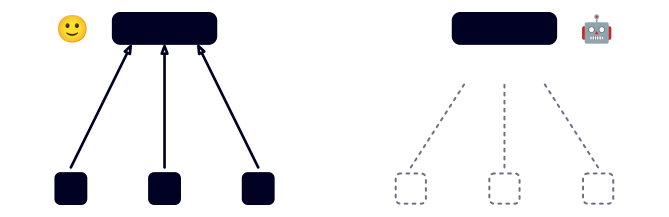
Traceable and untraceable
(Left) Human-only writing: sources can be checked; every citation can be checked against its source.
(Right) With AI involvement: the provenance of words and ideas is not fully recoverable, producing ghost citations and even fabricated ones.
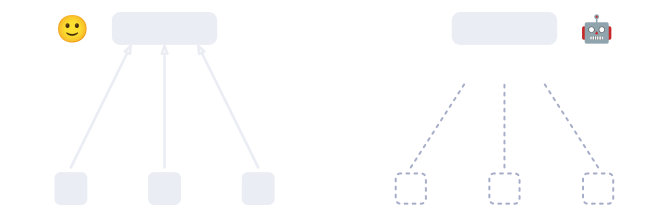
Traceable and untraceable
(Left) Human-only writing: sources can be checked; every citation can be checked against its source.
(Right) With AI involvement: the provenance of words and ideas is not fully recoverable, producing ghost citations and even fabricated ones.
Step back, and even if we could trace every missing citation, the costs are asymmetric: months to investigate, days to generate.
The remaining mismatch is more fundamental: the standing of the collaborator. Today AI in research is mostly a vehicle — you ride it, you decide where it goes, and if something happens, you are responsible. The larger trend is to make it a “collaborator”: it renders judgments, the human merely confirms, and responsibility disperses into a range no individual can control. The point is not whether it is a tool; the point is that the relationship has changed. When a tool errs, a person answers for it; when a collaborator errs, responsibility still cannot be shifted onto it. Responsibility has to land on a person — the institutions made this clear long ago.
These mismatches have one more consequence, and it deserves a name: deification. When a system is repeatedly called a “discoverer,” the way people ask questions changes. No longer “what has it read” but “what did it think of”; between helping speed research up and praying for a research result, it seems, there is only a low wall. And once our way of asking changes, the sources and grounds we press for disappear along with it.
We can accept an assistant that makes mistakes, and we can accept a product with limits; what is hard to accept is a collaborator that cannot say what it has read and cannot be questioned about the basis of its judgments. Rules for authorship and responsibility are not lacking; they simply stop at the level of the paper: a researcher’s own conscience covers only the individual, while the collaborator’s judgments have already entered the research process, and no one signs off on that process.
This doubt about provenance needs no conspiracy theory to feed it: as long as sources cannot be checked, we can rule out neither misuse nor coincidence. Repeated often enough, trust comes down to one question: believe by default, or distrust by default.
What this crisis damages is not even the trust we already have, but a trust that was never established. Trust between people is still propped up by centuries of norms and institutions; between people and AI, we have not even defined what the norms would govern. Doubt is therefore a poisoned seed: when it first sprouts, most people only discuss it in private; by the time it grows into a towering tree, what gets damaged is not one paper but the trust mechanism of the entire research system.
Mutual Withdrawal
If we try to imagine an institution that could serve as the remedy, what would it look like? The only answer I can come up with is one phrase: Mutual Withdrawal.
The term is one I coined myself: mutual withdrawal. It does not ask for a boycott of AI, only for a higher bar, with an exit left open on each of two sides. What gets raised is the default bar: nothing counts unless its sources can be checked. And the exits target only the side that does not keep to the norms.
First, the bar has to be made uniform: where sources cannot be checked, no matter who produced the work, we stop treating AI results as knowledge that already belongs to the community; when journals encounter such work, they should flag it separately and review it more strictly.
One exit faces the AI companies and their results. Against AI systems, and the companies behind them, that do not follow research norms, the community can stop supplying data: researchers can stop feeding them new research traces, and can stop trusting their results by default.
The other exit faces researchers. Flooding the literature with AI, fabricating citations, passing AI-generated content off as one’s own original work without disclosing it — most of these have existing machinery that can catch them: not disclosing AI use can be ruled misconduct under journal rules27, and in the future such behavior should be expressly classed as research misconduct. For these researchers, the pressure needs to be more proactive: retractions, limits on funding and on review eligibility, constraints from societies and from within labs — all of them tools for making “withdrawal” real.
Pressure on the researchers’ side is harder, and I have no one-step solution: the line between flooding and covert plagiarism is not always clear. What is missing is clearer disclosure rules, not heavier moral censure. Writing “what tools were used, at which stages, where the data came from” into the methods section is far more concrete, and far easier to enforce, than a blanket sentence saying “AI was used in this study.” Nor do the people making these determinations have to come from a new agency; journals and funders can judge individual cases, the way they handle plagiarism and fabricated citations today. It will just be slower.
Most of what this proposal needs is already in operation. Rules for authorship and disclosure are written into journal requirements; fabricated citations have processes for detection and handling. One analysis found that of the papers PubMed indexed in 2026, roughly one in 277 contained fabricated references — and that is only the easiest kind to catch31. The reproducibility crisis in psychology shows that the community can recalibrate its rules after failure29. What is missing is not the people who judge cases, but an enforcer that turns case-by-case judgment into a uniform standard.
This mechanism might work because what it changes is the cost structure: the gains from breaking the rules are immediate and land on the individual, while the costs are borne by the collective and show up only slowly. Fast gains and slow costs — that is how the scales are currently tilted. Make the penalty arrive before the payoff, and rational people will choose differently — and that step does not require persuading everyone. It has a side benefit too: it turns “whether to use AI, and how to use it” from a personal preference into a public question that can be argued over, demanded, and tested. None of this needs a moral campaign; it only needs the people who follow the rules not to lose out.
Self-organization is the starting point: journal editors can require authors to declare the scope of their AI use, societies can add a provenance check to their review processes, and labs can sign clearer terms with vendors about how their data is used.
Public institutions are the next step: once major funders and journals adopt the same disclosure requirements, vendors no longer face dozens of labs negotiating separately but a single uniform threshold — and withdrawal turns from a personal choice into an institutional consequence.
Worried this would hurt open science? It is the other way around: disclosing sources is worth something because not disclosing has a cost. Remove that cost and all you have left is a race to stockpile data first. This is not a new question; in the previous essay we already discussed institutions and distribution.
Research-trace data is destined to be collected. My concern is whether, along the way, trust gets taken with it.
Conclusion
The facts are already clear: AI is entering research, trace data is being collected, and the prices and the seats are there for anyone to see. The mechanism is not complicated either: research runs on the traceability built by citation and credit, and every link in it requires sources that can stand up to checking. The institutional proposal has exactly one plank: set a clear bar, add exit mechanisms — what cannot be checked does not count as established knowledge, and those who break the norms pay a cost.
The roads that led to a result — the forks and the dead ends that papers never write down — have for the first time a chance to leave a continuous record. That is where the weight of this data lies: mutual withdrawal targets how results are obtained and announced, not collection itself.
Picture a paper ten years from now. Its acknowledgments carry one extra line: “Parts of the process behind this study cannot be traced.” Reviewers may be used to it by then; readers may not give it a second glance. At that point, do we still believe in “AI discovery”?
A dragon may show its head while hiding its tail, but the community has to know which sky it flew through.
References
Footnotes
Ars Technica’s report on the December 2022 ArtStation artists’ protest, original (lede): “On Tuesday, members of the online community ArtStation began widely protesting AI-generated artwork by placing ‘No AI Art’ images in their portfolios.” https://arstechnica.com/information-technology/2022/12/artstation-artists-stage-mass-protest-against-ai-generated-artwork ↩
Adobe’s official blog, “Adobe partners with artists to power the new era of media & entertainment with Firefly Foundry” (2026-01-22), on AI tools finding their footing in professional film and TV production workflows. https://blog.adobe.com/en/publish/2026/01/22/adobe-partners-artists-power-new-era-media-entertainment-firefly-foundry ↩
AI copyright litigation in the music industry: UMG settled with Udio and signed a licensing deal in October 2025; Warner settled with Suno in November 2025; Sony has not settled. The Suno cases remain pending in Massachusetts federal court (UMG v. Suno, No. 1:24-cv-11611, D. Mass.); in Law Commentary’s words: “Both copyright cases remain pending in Massachusetts federal court.”; in March 2026, independent musicians filed a separate suit against Google (Lyria 3, ProducerAI), No. 1:26-cv-02582, filed 2026-03-06, with the full complaint published by Loevy. https://copyrightalliance.org/ai-copyright-lawsuit-developments-2025 — https://www.lawcommentary.com/articles/umg-sony-suno-ai-copyright-lawsuit-v6 — https://www.casemine.com/judgement/us/69d7ab2f64eb89b6c2004c31 — https://www.loevy.com/wp-content/uploads/2026/03/Kogon-v.-Google.-Complaint-Filed-1.pdf ↩ ↩2
Terence Tao’s comment on Mathstodon about the prospects for AI collaboration in mathematics (2026-09-08), original: “it is now the identification of a promising problem which is the scarce and precious resource. We have now seen that even the rumor of someone working on a problem can trigger a massive amount of AI-powered effort to flatten it before the original research project has time to reach its full potential. The incentives may now be pointing in the direction of no longer sharing any promising research directions with the broader community, which would reverse centuries of traditions of open science and do serious long-term damage to the future of the field.” https://mathstodon.xyz/@tao/117237322160500501 ↩ ↩2
The size of the expert-data market: per Dealroom, Mercor reached over $2 billion in gross annualized revenue in June 2026 (up from $1 billion at the start of the year); Dealroom, original: “It now pays over $2 million a day to more than 30,000 weekly active contractors.”, noting that the figure “reflects total customer spend before contractor payouts, not net revenue retained.” Mercor’s own blog (2026-05-08): “we pay out over $2 million every day to more than 30,000 weekly active contractors across the world.” https://app.dealroom.co/news/note/mercor-doubles-to-2b-gross-revenue-run-rate-as-ai-labs-buy-expert-data — https://www.mercor.com/blog/when-you-go-from-2-million-a-month-to-2-million-a-day/ ↩
Anthropic’s announcement “Expanding our support for scientists” (2026-08-27), original: “We are opening 10,000 seats for scientists around the world to access Claude subscriptions for free and at discounted rates for one year… Standard seats will be free and premium seats with 5x usage limits will be available for $15 per month.”; the announcement also writes: “Over the coming months, we intend to extend this program well beyond the initial 10,000 seats.”; AI for Science projects have a per-project cap of $50,000. https://www.anthropic.com/news/expanding-support-for-scientists ↩
Anthropic’s announcement “Claude Science, an AI workbench for scientists” (2026-06-30), which says the product “produces auditable artifacts” — that is, the research process settling into an auditable record; Anthropic’s own enzyme discovery work was done in this workbench and in Claude Code. https://www.anthropic.com/news/claude-science-ai-workbench ↩
xAI’s release of “Grok Code Fast 1” (2025-08-28), original: “We’ve teamed up with select launch partners to offer `grok-code-fast-1` for free for a limited time, including GitHub Copilot, Cursor, Cline, Roo Code, Kilo Code, opencode, and Windsurf.”; API pricing: $0.20 per million input tokens and $1.50 per million output tokens. https://x.ai/news/grok-code-fast-1 ↩
Google’s official Gemini CLI documentation: a personal Google account gets a free tier of “60 requests/min and 1,000 requests/day with personal Google account”, with a 1M-token context. https://google-gemini.github.io/gemini-cli ↩
The 2024 Nobel Prize in Chemistry went to David Baker (computational protein design, one half) and to Demis Hassabis and John M. Jumper (protein structure prediction, sharing the other half). Nobel Prize original: “In 2020, Demis Hassabis and John Jumper presented an AI model called AlphaFold2. With its help, they have been able to predict the structure of virtually all the 200 million proteins that researchers have identified.” https://www.nobelprize.org/prizes/chemistry/2024/press-release ↩
Google DeepMind published GNoME (Graph Networks for Materials Exploration) in Nature on November 29, 2023, discovering 2.2 million new crystal structures. https://deepmind.google/blog/millions-of-new-materials-discovered-with-deep-learning ↩
Google released AI co-scientist in February 2025, a Gemini 2.0-based multi-agent system for generating and ranking research hypotheses; in a validation task on antimicrobial resistance mechanisms it reproduced key hypotheses, with an accompanying paper in Penadés et al., Cell, 2025. https://research.google/blog/accelerating-scientific-breakthroughs-with-an-ai-co-scientist ↩
Anthropic research note (2026-08-10): an unreleased research version of Claude pushed a lower bound related to the Riemann zeta function from 41.6% to 67.2%, with Anthropic stating explicitly that the Riemann hypothesis itself remains unsolved. https://www.anthropic.com/research/riemann-zeta ↩
OpenAI’s announcement “On the Navier–Stokes Millennium Prize Problem” (2026-09-08, updated 09-10): a coordinated agent system driven by its internal models proved that the three-dimensional incompressible Navier–Stokes equations admit a finite-time singularity, with formal verification completed in Lean. Original: “the group that produced the Navier–Stokes resolution involved on the order of 10,000 concurrent agents”; the announcement also writes “Our effort began on September 1st after hearing a rumor which we later realized was related to Levent Alpöge, an Anthropic employee, and Tristan Buckmaster, a math professor at NYU.”; and “We do not intend to claim the Millennium Prize for this result.” It writes versions C and D into its statement of the result: “we suggested versions ‘A’ and ‘B’ (particular forms of the Navier–Stokes problem which would result in a proof) and versions ‘C’ and ‘D’ (which would result in a disproof)”, “This resolves the Navier–Stokes Millennium Prize problem by establishing statement ‘C’ (and also ‘D’) in the official Millennium Prize formulation.”; it also writes: “We recognize the priority of their work on forced Euler and congratulate them on their remarkable mathematical achievement.” https://openai.com/index/navier-stokes-solution ↩ ↩2 ↩3 ↩4 ↩5
Tristan Buckmaster’s (NYU) public statement on the priority dispute (2026-09-08), original: “I asked whether the model had been trained on, or had access to, our sessions in Codex, into which we had been putting all our drafts for the whole of this project. I was told the model did not look up user data. I asked again, about training, and I did not get an answer.”; the statement also records a reply from an exchange: “I said that if OpenAI released its result in the way proposed I would go public with what happened. The reply was, ‘Why would you ruin your career?’”; and it writes “The route to the Clay problem through a smooth force, options c and d in Fefferman’s statement of the problem, is the route Luis and Diego opened and the one Levent and I had quietly chosen to attack. Almost nobody else I know of was working on it.” https://cims.nyu.edu/~tristanb/statement.pdf ↩ ↩2 ↩3 ↩4
OpenAI’s response to the same dispute (first version of the announcement, 2026-09-08): “We (the researchers and the agents) did not see any of their work through any means until they released it publicly — in particular, no specific user data was accessed in order to solve this problem. While unlikely, we cannot rule out that de-identified data derived from their usage of our products helped improve our models.”; the “While unlikely…” sentence was removed from the live page in the 09-10 update. First-version snapshot: https://web.archive.org/web/20260908171518/https://openai.com/index/navier-stokes-solution — current version: https://openai.com/index/navier-stokes-solution ↩ ↩2
Scientific American on mathematicians questioning whether OpenAI solved the “right” Navier–Stokes problem (2026-09-21), Luis Silvestre, original: “The most important problem is unsolved. The Clay problem is settled, but the main problem for the Navier–Stokes equations is not.”; Constantin, Ignatova, and Vicol posted arXiv:2609.20803 on 2026-09-17, showing that the forced construction does not extend. https://www.scientificamerican.com/article/did-openai-solve-the-wrong-navier-stokes-problem ↩ ↩2
Anthropic’s announcement “Claude discovers a novel enzyme system with CRISPR-like repeats” (2026-09-23), original: “Claude discovered a novel enzyme system with properties reminiscent of CRISPR, with only high-level direction from our scientists”, and stating explicitly “All of the lab work is performed by human scientists.”; the search ran on roughly 950 agents, 21 hours, and 210 million tokens; the system is named ART (array-associated reverse transcriptases), its function is still unknown, and the preprint has not been peer-reviewed. https://www.anthropic.com/news/claude-discovers-novel-enzyme-system ↩ ↩2
Mario Rodríguez Mestre, a computational biologist at the University of Copenhagen, told The New York Times on 2026-09-27 that his team had studied ART-class enzymes for four years and, over the past three years, had shared key findings with Anthropic while using its models. Original: “So, for me, the most important question is not ‘Were ARTs already known?’ They were.”; “My concern is that this information was used to train future versions of the models.” https://www.nytimes.com/2026/09/27/science/anthropic-biology-enzyme-mestre.html ↩ ↩2
Philip Kranzusch, a microbiologist at Harvard Medical School, on the same discovery (NYT, 2026-09-24), original: “It’s not yet a breakthrough. It’s a wrinkle on what we know in the field.” https://www.nytimes.com/2026/09/24/science/anthropic-biology-lab-enzyme.html ↩ ↩2
Kevin Blake, a microbiologist at the University of Washington School of Medicine, told Al Jazeera (2026-09-24), original: “There’s nothing to indicate this is a rival to CRISPR-the-technology, or could be developed into any kind of therapeutic or practical application.” https://www.aljazeera.com/economy/2026/9/24/ai-model-claude-discovers-crispr-like-enzyme-system-anthropic-says ↩
Source for the key time gap: Quanta Magazine (2026-09-08), original: “The OpenAI announcement of this long-sought singularity came 12 hours after an announcement from Tristan Buckmaster at New York University that he, together with Levent Alpöge at Anthropic, had resolved several closely related problems.”; the Wikipedia article “Navier–Stokes priority controversy” (a third-party compilation with citations to the original posts) likewise records “an announcement on 8 September, approximately 12 hours after Buckmaster’s post.” https://www.quantamagazine.org/ai-has-solved-one-of-maths-1-million-millennium-prize-problems-20260908 — https://en.wikipedia.org/wiki/Navier%E2%80%93Stokes_priority_controversy ↩
A joint statement by 25 Fields Medalists, “A Severe Misalignment of AI in Mathematics” (2026-09-11, DOI 10.5281/zenodo.22737750), original: “Often these solutions are announced in a rush, leaving no time for a proper writeup, the isolation of new methods and ideas, and citing relevant previous work of others. As in all creative professions, this raises severe attribution and plagiarism questions.” https://mathandai.org/ ↩
Robert K. Merton, “The Normative Structure of Science” (1942; originally titled “A Note on Science and Technology in a Democratic Order”), proposed the four sets of institutional norms of science, i.e. CUDOS, original: “Four sets of institutional imperatives - universalism, communism, disinterestedness, organized skepticism - are taken to comprise the ethos of modern science.” Here communism requires that scientific knowledge belong to the community: researchers must publish their results and acknowledge their sources. https://www.panarchy.org/merton/science.html ↩
Robert K. Merton, “Priorities in Scientific Discovery: A Chapter in the Sociology of Science,” American Sociological Review 22(6): 635–659, 1957: argues that priority disputes are not an incidental product of self-centered human nature but arise structurally from the reward system’s prizing of “originality” — that is, from the tension between disclosing sources and securing priority. https://www.academia.edu/34402380/Merton_Robert_K_1957_Priorities_in_Scientific_Discovery ↩
Merton’s norms have been criticized since the 1970s as descriptively false; the counter-norm to communism is secrecy, original: “Scientists protect their newest findings to ensure priority in publishing, patenting, or applications.” https://en.wikipedia.org/wiki/Mertonian_norms ↩
ICMJE (International Committee of Medical Journal Editors) recommendations on AI use by authors, original: “Chatbots (such as ChatGPT) and other AI-assisted tools should not be listed as authors because they cannot be responsible for the accuracy, integrity, and originality of the work…”; “Referencing AI-generated material as the primary source is not acceptable.”; “Nondisclosure of AI use may require corrective action and may be construed as misconduct in some circumstances.” https://www.icmje.org/recommendations/browse/artificial-intelligence/ai-use-by-authors.html ↩ ↩2
X-ray diffraction image “Photograph 51,” taken by Rosalind Franklin and Raymond Gosling at King’s College London on May 2, 1952; in January 1953, Wilkins showed it to Watson, and Watson and Crick deduced the DNA double helix from it; Franklin’s data was used without her consent. https://www.kcl.ac.uk/the-story-behind-photograph-51 ↩
Open Science Collaboration (roughly 270 researchers working together), “Estimating the reproducibility of psychological science,” Science 349(6251): aac4716, 2015, abstract original: “Ninety-seven percent of original studies had statistically significant results. Thirty-six percent of replications had statistically significant results.”; the crisis subsequently drove institutional reforms such as preregistration and data sharing. https://www.science.org/doi/10.1126/science.aac4716 — https://www.cos.io/about/news/massive-collaboration-testing-reproducibility-psychology-studies-publishes-findings ↩ ↩2
On October 31, 2025, arXiv issued an official statement: review articles and position papers in all computer science categories must be published in a peer-reviewed journal or conference before they can enter the preprint repository. The reason given: “In the past few years, arXiv has been flooded with papers. Generative AI / large language models have added to this flood by making papers – especially papers not introducing new research results – fast and easy to write.” https://blog.arxiv.org/2025/10/31/attention-authors-updated-practice-for-review-articles-and-position-papers-in-arxiv-cs-category/ ↩
An analysis reported by Retraction Watch (2026-05-07): about one in every 277 papers indexed by PubMed in 2026 contains fabricated references; the analysis comes from a letter to The Lancet by Max Topaz of Columbia University and others, and Mohammad Hosseini of Northwestern University comments that the number is “low-hanging fruit” and the “tip of the iceberg,” with the “bigger and more important problem” being inaccurate or biased AI-generated citations. https://retractionwatch.com/2026/05/07/one-in-277-pubmed-indexed-papers-in-2026-shows-fabricated-references-says-analysis ↩